Linear maps¶
Mathematical objects gain a lot of richness when they can be related to each other. In linear algebra, the objects of interest are vector spaces, and the way the relate to each other is by means of linear maps. The word “map” is being used as a synonym to the word “function”.
Definition and first examples¶
Definition 4.1 (Related exercises: Exercise 6.13, Exercise 7.15, Exercise 4.17, Exercise 4.11, Exercise 4.12, Exercise 4.21)
Let \(V, W\) be two vector spaces. A function \(f : V \to W\) is called linear (or a linear map, or a linear transformation) if it satisfies the following conditions:
(4.2)
and
(4.3)
The vector space \(V\) is called the domain of \(f\), \(W\) is called the codomain of \(f\).
Remark 4.4 (Related exercises: Exercise 4.17, Exercise 4.11, Exercise 4.12)
These two conditions can be squeezed into one condition, by requiring that
for all \(a, a' \in {\bf R}\) and all \(v, v' \in V\). This can be paraphrased by saying that \(f\) preserves linear combinations.
Using that \(0 \cdot v = 0_V\) (the zero vector in \(V\)), the above condition implies that
Thus, for a linear map, the zero vector of \(V\) is mapped to the zero vector in \(W\).
Example 4.5
The map \(f : {\bf R}^2 \to {\bf R}^2\), \(f (x,y) := (x, -y)\) (i.e., reflection at the \(x\)-axis) is linear. This can be proven very simply algebraically: for Equation (4.2): if \(v = (x,y)\) and \(v' = (x', y') \in {\bf R}^2\), then
Checking Equation (4.3) is similarly simple. The linearity of the map can also be visualized geometrically:
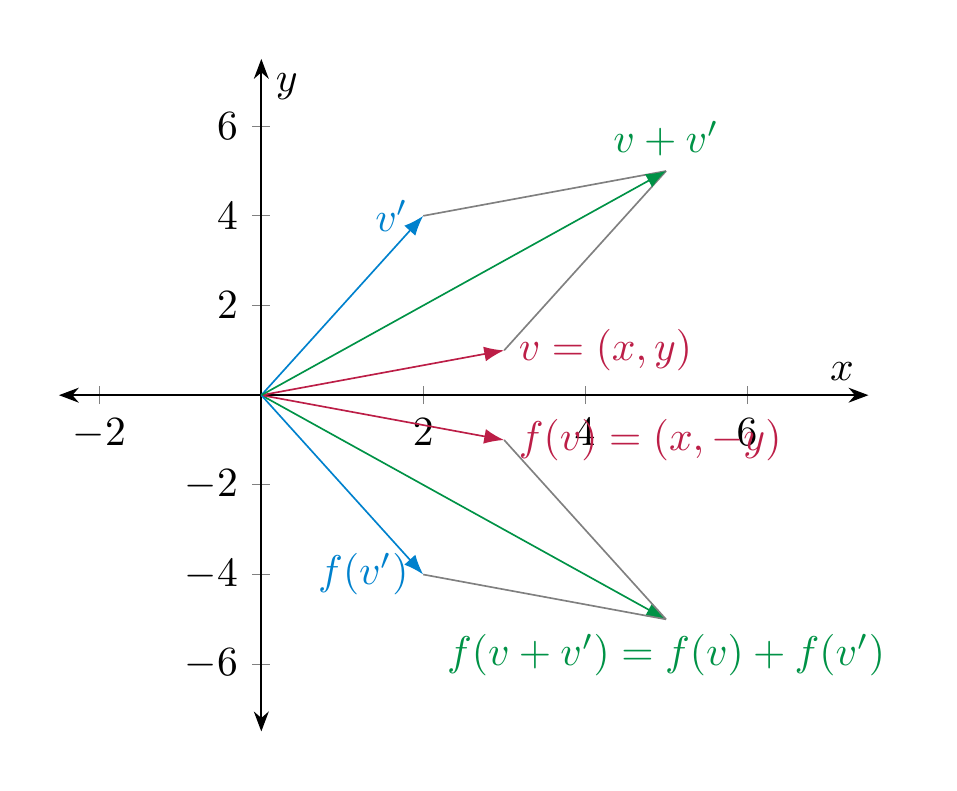
We will soon regard the preceding example as a special case of the multiplication of a vector with a matrix, namely in this case the matrix \(\left ( \begin{array}{cc} 1 & 0 \\ 0 & -1 \end{array} \right )\), cf. §Section 4.2.
Example 4.6
The map
i.e., the derivative of \(f\), is linear. This is true because we have the formulae (proven in calculus)
Alternatively, one may use that the derivative of a polynomial \(f(x) = \sum_{n=0}^d a_n x^n\) is given by \(f'(x) = \sum_{n=1}^d n a_n x^{n-1}\). Then, for \(g = \sum_{n=0}^d b_n x^n\), we check Equation (4.2), say:
Here are a few slightly more abstract examples of linear maps, in which \(V\) is an arbitrary vector space.
Example 4.7 (Related exercises: Exercise 4.17)
-
The identity map \({\mathrm {id}} := {\mathrm {id}}_V : V \to V\) which is given by \({\mathrm {id}}(v) := v\) is linear.
-
For some other vector spaces \(W\), the zero map \(0 : V \to W\) is the map sending every vector \(v\) to \(0_W\). It is linear.
-
For any real number \(a \in {\bf R}\), the map given by scalar multiplication \(V \to V\), \(v \mapsto a \cdot v\) is linear. This follows from the conditions 4. and 6. in the definition of a vector space (Definition 3.10).
Non-Example 4.8
-
The map \(f : {\bf R} \to {\bf R}\), \(f(x) := x^2\) is not linear. Indeed, \(f(x + y) = (x+y)^2 = x^2 + 2xy + y^2 \ne x^2 + y^2 =f(x) + f(y)\). Also \(f(ax) = a^2 x^2 \ne ax^2 = af(x)\).
-
The map \(f : {\bf R} \to {\bf R}\), \(f(x) := x+1\) is not linear since again
Thus, Equation (4.2) is violated. Also Equation (4.3) is violated: \(f(ax) = ax+1 \ne a(x+1) = af(x)\).