Determinants of larger matrices
There are various (equivalent) approaches to defining determinants of larger matrices. The following one is satisfactory from both a conceptual and a practical standpoint.
Theorem 5.5 (Related exercises: Exercise 5.2, Exercise 5.4)
There is a unique function, called the determinant,
with the following properties (throughout \(A \in {\mathrm {Mat}}_{n \times n})\):
-
\(\det ({\mathrm {id}}_n) = 1\),
-
If \(A'\) results from \(A\) by interchanging two rows, then
(5.6)
- Let us write a matrix as \(\left ( \begin{array}{c} v_1 \\ \vdots \\ v_n \end{array} \right )\), i.e., \(v_i \in {\bf R}^n\) is the \(i\)-th row of the matrix. Then for any \(w \in {\bf R}^n\) and any \(r \in {\bf R}\):
Remark 5.7 (Related exercises: Exercise 5.6)
The above operations are somewhat like elementary operations (Definition 2.28): if we take \(w = 0\) above, then the formula says that multiplying any one row by \(r\) (which may be zero, unlike in Definition 2.28), then the determinant also gets multiplied by \(r\). In particular, if \(A\) has a zero row, then
(5.8)
Remark 5.9 (Related exercises: Exercise 5.6)
We also have
whenever two rows of \(A\) are equal: indeed, the matrix \(A'\) obtained by interchanging these rows is equal to \(A\), i.e., \(A' = A\), so that \(\det A = \det A'\). However, according to , we also have \(\det A' = - \det A\). Taking this together, we have
and this is only possible if \(\det A = 0\).
Remark 5.10
The preceding remark also implies that for \(i \ne j\) and \(r \in {\bf R}\)
In other words, adding an arbitrary multiple of some row to another row does not affect the determinant.
In order to get a feeling for this theorem, let us apply it to a concrete matrix, say
Taking the theorem for granted, we will compute \(\det A\) by stepwise applying the above rules and keeping track of how the determinant changes.
From \(A\) to \(A_1\) to \(A_2\) to \(A_3\), we have added appropriate multiples of some row to another one, so that
We obtain \(A_4\) from \(A_3\) by multiplying the last row with \(- \frac 18\), so that \(\det A_4 = -\frac 18 \det A_3\). From \(A_4\) to \(A_5\) to \(A_6\) to \(A_7\), we again added appropriate multiples to some other rows, so that
Finally, \(A_8\) is obtained from \(A_7\) by swapping the first two rows, so that
Taking this all together we see that
This shows that the above abstract description of the determinant can be used to compute determinants in practice.
Proof. (of Theorem 5.5) We only sketch the proof idea: one basically proceeds, for a general square matrix, similarly to the computation above: one uses Gaussian elimination, i.e., elementary row operations to bring a given square matrix \(A\) into reduced row-echelon form, say \(A \leadsto A'\). The properties in Theorem 5.5 then imply how to compute \(\det A\) in terms of \(\det A'\). If the resulting matrix \(A'\) has a zero row, then \(\det A' = 0\). If it has no zero row, then \(A' = {\mathrm {id}}\), and \(\det A' = 1\). ◻
Small matrices
For practical purposes, it is useful to have an explicit formula at hand for small matrices:
For a \(1 \times 1\)-matrix \(A\), i.e., \(A = (a)\), we have
The determinant of \(2 \times 2\)-matrices defined in Definition 5.1 satisfies the properties listed in Theorem 5.5.
-
\(\det {\mathrm {id}}_2 = \det \left ( \begin{array}{cc} 1 & 0 \\ 0 & 1 \end{array} \right ) = 1 \cdot 1 - 0 \cdot 0 = 1\).
-
Swapping two rows yields a sign change in the determinant (Lemma 5.4).
Thus, the definition of \(\det\) for general matrices agrees with the one in Definition 5.1.
Lemma 5.11 (Related exercises: Exercise 5.1, Exercise 5.4, Exercise 5.7, Exercise 6.14, Exercise 6.15)
For a \(3 \times 3\)-matrix one can show that the determinant is given by the so-called Sarrus’ rule:
(5.12)
Proof. One can prove by direct computation, that the function defined in satisfies the conditions in Theorem 5.5. ◻
A way to remember this formula is to write
and take products of entries along the top-left-to-bottom-right diagonals with a positive sign, and the top-right-to-bottom-left diagonals with a negative sign:
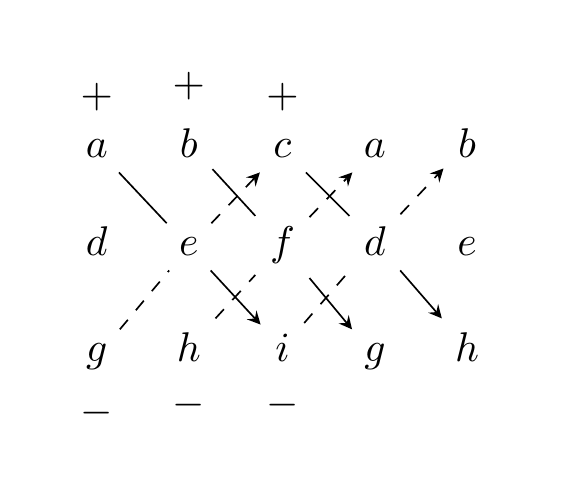
Sarrus’ rule does not apply to larger matrices. Instead, for matrices of size \(4 \times 4\), one can prove that \(\det A\) is the sum of 24 expressions, each of which is a product of 4 entries of \(A\). See Exercise 5.4 for a fully worked computation of a determinant of a \(4 \times 4\)-matrix using different methods.