Determinants
Determinants of \(2 \times 2\)-matrices
We begin with the definition of determinants of \(2 \times 2\)-matrices.
Definition 5.1 (Related exercises: Exercise 5.3)
Let
be a \(2 \times 2\)-matrix. The determinant of \(A\) is defined as
Example 5.2
-
\(\det \left ( \begin{array}{cc} 4 & 7 \\ 2 & -1 \end{array} \right ) = 4 \cdot (-1) - 7 \cdot 2 = -18\).
-
\(\det \left ( \begin{array}{cc} 1 & r \\ 0 & 1 \end{array} \right ) = 1 \cdot 1 - r \cdot 0 = 1\). In particular, \(\det {\mathrm {id}}_2 = 1\).
-
Consider a matrix \(A = \left ( \begin{array}{cc} a & b \\ ra & rb \end{array} \right )\) whose second column is a multiple of the first (so that the columns are linearly dependent). Then
According to Corollary 4.94, \(A\) is not invertible. This is an example of the fact alluded to above (cf. Theorem 5.15).
Determinants carry the following geometric meaning. Recall that the absolute value of a real number \(r\) is defined as
For example, \(|4| = 4\) and \(|-5| = 5\).
Lemma 5.3
Let
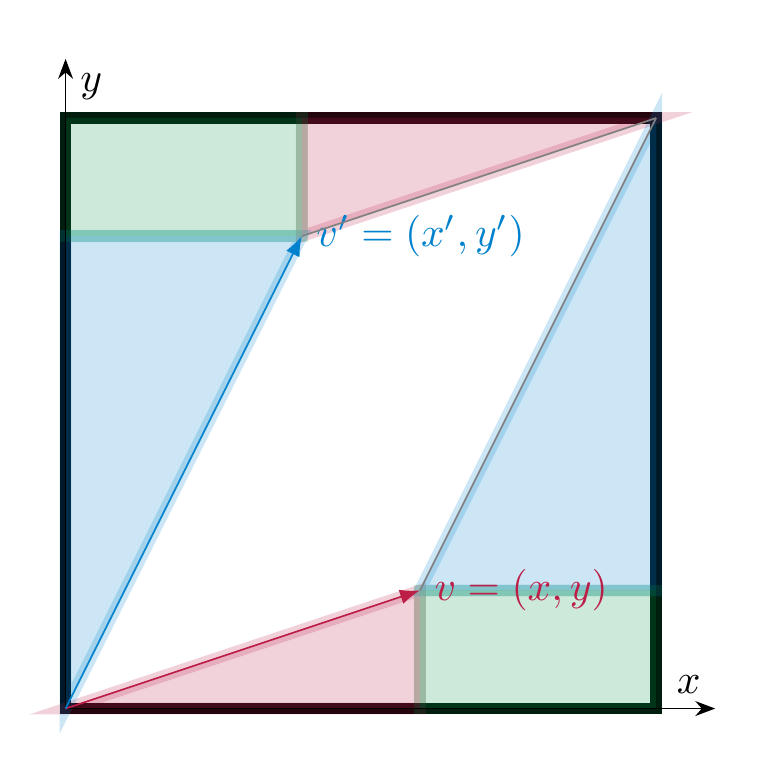
be a \(2 \times 2\)-matrix, where \(v\) and \(v' \in {\bf R}^2\) are the two columns of \(A\). Then
where the right hand side denotes the area of the parallelogram spanned by the two vectors \(v_1, v_2\).
Proof. We illustrate this geometrically in the case where all entries of \(A\) are positive and the vectors \(v\) and \(v'\) lie as depicted, i.e., the angle from \(v\) to \(v'\) goes, informally speaking, counterclockwise. The area of the black rectangle is \((x+x')(y+y')\). The area of the two triangles whose long side is \(v\) (resp. parallel to it), is \(\frac{xy}2\), so the area of these two triangles together is \(xy\). Likewise the total area of the triangles (parallel to) \(v'\) is \(x'y'\). Finally, the area of the rectangle at the bottom right, resp. top left corner of the large rectangle is \(x'y\). Therefore, the area of the parallelogram is
◻
Lemma 5.3 does not give any information about the sign of the determinant. Regarding that, we observe the following:
Lemma 5.4
Let \(A = \left ( \begin{array}{cc} x_1 & x_2 \\ y_1 & y_2 \end{array} \right )\) and let
be the matrices obtained from \(A\) by swapping the two columns, resp. the two rows. Then
In other words, swapping two rows or two columns will change the sign of the determinant.
Proof. This is directly clear from the definition. For example,
◻
Thus, the determinant (as opposed to only its absolute value) records the area of the parallelogram spanned by the vectors and also the orientation.